AI-Augmented Ops Intelligence: Amplifying Expertise, Not Replacing It.
Groveline's AI engine applies your rules, vocabulary, and grading criteria across every diligence review, with evidence attached to every conclusion.
It does not decide what "good" looks like. Your standards do. The engine scales them with speed, consistency, and audit-ready proof.
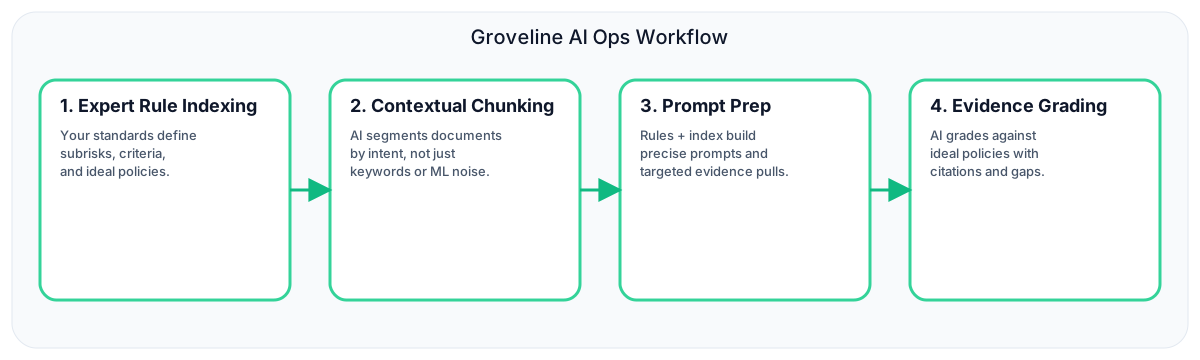
Expert rules in, evidence-backed grades out.
Why this engine works
Built from real ODD workflows, designed to turn expert judgment into consistent, explainable output.
Expert-First
You define the rules, thresholds, and ideal policy standards. AI follows your playbook.
Context-Aware
Contextual chunking captures nuance that keyword search and generic ML miss.
Evidence-Backed
Every grade links to source proof, gaps, and confidence so decisions hold up in committee.
The 4-Stage Engine
A disciplined pipeline that keeps human judgment in control while AI handles the heavy lifting.
Expert Rule Indexing
Capture your subrisk definitions, thresholds, and ideal policies as the standard.
Contextual AI Chunking
AI segments documents by intent and nuance, outperforming traditional ML and keyword matching.
Prompt Prep
Prompts include your rules and evidence index, guiding precise retrieval and evaluation.
Evidence-Based Grading
AI grades against ideal policies, returning citations, gaps, and confidence.
Real-world impact
The same structured data indexing and LLM-driven workflows have already produced material time savings in live operating environments.
Assessment delivery compressed through structured indexing and automated evidence pulls.
Automated extraction and exception logic collapsed overnight workflows.
Evidence tables and audit trails make decisions defensible, not just fast.
The path to real solutions
The AI engine is only the first step. The real value shows up when evidence becomes decisions, and decisions become durable operations.
Allocator use case
An allocator defines the rules and sub-risks, provides manager documents, and receives consistent, evidence-backed outputs.
- *ODD reports with cited evidence
- *Remediation roadmap and gaps
- *Portfolio-level consistency across teams
Emerging manager path
Your expertise sets the grading rules, then AI assesses readiness through the allocator lens. From there, the work turns into real operating improvements.
- *DDQ and policy alignment in your voice
- *Vendor selection for exact operational fit
- *Implementation support to build or fix real ops
Building under real constraints
The smartest operators are the ones who can reason under uncertainty, assess constraints of time, money, and people, and still make decisions that build trust.
That has been the story of my career: turning fragile, high-risk spreadsheet processes into scalable systems that supported billions in AUM, automating overnight workflows from forty hours to one, and stepping into messy situations to stabilize operations and preserve client relationships.
As AI takes on more technical execution, the differentiator is still judgment--asking the right questions, sequencing decisions, and orchestrating people and tools in ways that hold up under pressure. AI implementation requires the same rigor as any ops build.
Control stays with you
Analysts review outputs, refine rules, and override grades with a documented trail. AI accelerates the process, but judgment remains human.
- *Every grade ties to source evidence and explicit criteria.
- *Overrides are logged so you can see where judgment adjusted the model.
- *Frameworks evolve with your standards without retraining a model.
Your documents stay in your workspace. We do not train models on client data.
Schedule a Demo
See how expert rules, contextual AI, and evidence-based grading scale diligence without losing control.